


How to Play Rail Shots in Billiards and Why Rail Shots Tend to Bounce Out
By the billiards table, rail shots (balls close to the table rails) are often a nightmare for enthusiasts: even though you clearly aim at the pocket, the object ball either bounces off the rail like a “runaway horse” or deviates from the expected path after being struck. This seemingly simple shot type actually tests the comprehensive understanding of rail rebound rules, aiming angles, and force control. With its precise rail elasticity and table feedback, SPKI billiard tables help players master the core skills of rail shots faster, eliminating the trouble of “bouncing out.”
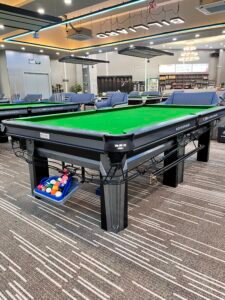
The Core Reason Why Rail Shots Easily Bounce Out
When playing rail shots, the object ball tends to bounce off the rail or deviate from the path, essentially due to insufficient control over the “rail rebound effect” and “aiming deviation.” First, when a rail shot is too close to the rail (usually less than 10 cm), the object ball may hit the rail first before rolling toward the pocket after being struck, and the rail’s elasticity will change the ball’s trajectory. On ordinary billiard tables, aging rail rubber or uneven elasticity causes rebound angles to fluctuate, leading to mistakes even with accurate aiming due to abnormal rebounds.
Second, aiming at rail shots involves “visual errors”: when the object ball is close to the rail, the gap between the ball and the rail interferes with aiming judgment, making it easy to mistakenly take the “line between the ball’s edge and the pocket” as the real aiming line, resulting in offset strike points. SPKI billiard tables feature rounded rail transitions to reduce visual interference, and their rail rubber undergoes multiple calibration processes, with rebound angle errors < 2°, allowing players to more clearly perceive rail rebound rules.
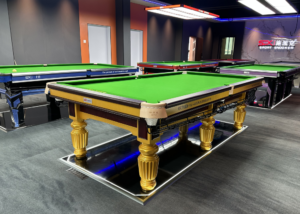
Aiming Tips for Rail Shots: Finding the “Invisible Aiming Point”
The key to playing rail shots is correcting the aiming angle and establishing a “rail compensation awareness.” When facing rail shots, professional players mentally construct a “virtual extension line”: fine adjustment the object ball’s pocket point away from the rail to compensate for possible deviations caused by rail rebounds. Specifically: if the object ball is frozen to the rail, the aiming point needs to shift 1-2 mm toward the inside of the pocket compared to the conventional aiming point to prevent the object ball from “bouncing outward” after hitting the rail; if the object ball is 3-5 cm from the rail, you can visually aim with the cue, aligning the cue tip, the object ball’s strike point, and the pocket’s center into a “corrected straight line.”
SPKI billiard tables can be fitted with special “aiming assist stickers” on the table surface, marking corrected aiming points for rail shots at different distances, helping beginners quickly build muscle memory. A coach shared: “Practicing rail shots on SPKI tables allows students to intuitively see trajectory differences before and after correction, mastering aiming compensation skills in just 2 weeks.”
Force Control: Light Force is the “Key to Stability”
Rail shots require more precise force control, and “light force + short stroke” is the core principle to avoid bouncing out. Excessive force causes violent rebounds when the object ball hits the rail, while insufficient force may prevent the object ball from reaching the pocket due to cloth resistance. The correct way to apply force is: shorten the cueing stroke to 1/2 of a regular shot, use small forearm swings to drive the cue, keep the wrist stable at the moment of impact, and let the object ball slide toward the pocket in a “table-hugging” manner.
SPKI’s high-density table cloth has excellent smoothness, ensuring uniform rolling resistance for the object ball. Combined with the high flatness of its blue stone table surface, the deviation of shots with the same force can be controlled within 3 cm, far lower than the 8 cm of ordinary tables. This allows players to precisely control force intensity and gradually find the “critical point” for rail shot force.
Strategies for Rail Shots in Different Scenarios
Flexible skill adjustments are needed for rail shots in different positions:
Frozen-to-rail shots: Use a “thin cut” technique, striking the outer 1/4 of the object ball while reducing force, making the ball slide toward the pocket at a small angle to avoid hitting the rail.
Near-rail shots (5-10 cm from the rail): Correct the aiming point toward the inside of the pocket, strike with medium force, ensuring the object ball reaches the pocket first before slightly touching the rail, using rail elasticity to assist pocketing.
Rail reverse-angle shots: Require greater aiming correction. You can control the rebound angle by applying English (side spin) to the cue ball. SPKI’s table cloth conducts ball spin more clearly, with stable English effects, facilitating correction of rail rebound trajectories.
Equipment Selection: Stable Rails are the “Cornerstone of Success”
Rail issues on ordinary tables are the main cause of rail shot mistakes: aging rubber leads to insufficient elasticity, and deformed rails interfere with trajectories, making practice inefficient. SPKI designed a “competition-grade rail system” for rail shot training: rubber uses imported high-elastic materials, with elasticity calibrated quarterly; the connection between rails and table surface is seamlessly fitted to avoid ball jams or bounces.
Whether for home practice or commercial halls, choosing SPKI billiard tables reduces “unexpected mistakes” in rail shots. As professional players say: “Playing rail shots on SPKI tables allows you to clearly predict every rebound—this controllability doubles the efficiency of skill improvement.”
Mastering rail shot skills lies in understanding rebound rules, correcting aiming deviations, and controlling force intensity, while stable equipment makes this process more efficient. Choose SPKI billiard tables to get precise feedback from every rail shot practice. When you can easily handle frozen-to-rail shots and reverse-angle shots, your billiards skills will naturally reach a new level.